


Men's Malachite





Men's Malachite Rings & Serpent Rings
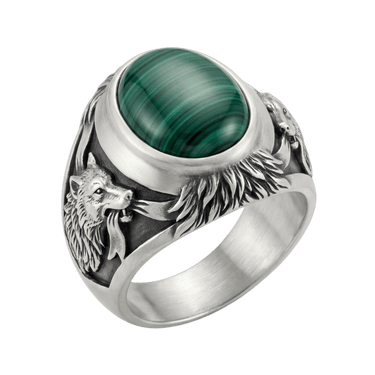
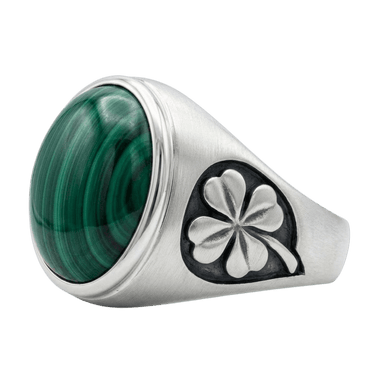
Men's malachite rings showcase natural green banding paired with sculpted mythological themes. This focused collection centers on detailed sterling silver rings, highlighting the contrast between vivid copper-rich stone and dark metalwork. Each piece features distinctive motifs such as the serpentine Medusa and intertwined toi et moi serpent bands. Cast in 925 sterling silver, these rings are detailed with an oxidized silver finish or available in polished silver and warm gold vermeil.
The symbolism of malachite, Medusa, and the serpent
Malachite is a copper carbonate mineral revered since antiquity for its parallel banded layers and deep forest-green hue. In Greek mythology, Medusa functioned as a fierce apotropaic ward, whose serpentine gaze protected sacred spaces and deflected harm from the wearer. The serpent itself represents cyclic renewal, shedding its skin to symbolize resilience and transformation. When paired in a toi et moi structure, double serpents represent two complementary forces bound in balance.
Selecting between a Medusa portrait and a double serpent ring
A bold Medusa figure commands attention on the index or middle finger, where the broad oval cabochon and flanking snakes have room to sit flat against the hand. In contrast, the double serpent toi et moi ring wraps the finger with twin coiled bodies, making it a comfortable choice for daily wear on the ring finger. If you prefer deep black tones instead of vibrant green, consider Men's Onyx rings. Those seeking ultramarine blue or fiery red hues can compare these bands against Men's Lapis Lazuli or Men's Garnet rings.
Casting green gemstone settings in 925 sterling silver
Sarnion casts each ring from 925 sterling silver, using lost-wax methods to capture fine serpent scales and facial contours. Controlled chemical oxidization darkens the deep crevices around the Medusa curls and snake textures, creating sharp visual depth that highlights the polished silver ridges above. Natural malachite slabs are cut and bezel-set to secure the fragile mineral safely against the metal. Solid 10K, 14K, and 18K gold versions are also available on request.
Occasions for gifting a silver malachite ring
Green malachite rings serve as a memorable gift for classical mythology enthusiasts, history scholars, and admirers of uncommon minerals. The vibrant banding marks milestone birthdays, personal transformations, or personal triumphs with a distinct color signature rarely seen in traditional men's jewelry. Serpent rings also make meaningful gifts for those navigating major career pivots or life transitions, honoring their endurance and forward momentum.
