


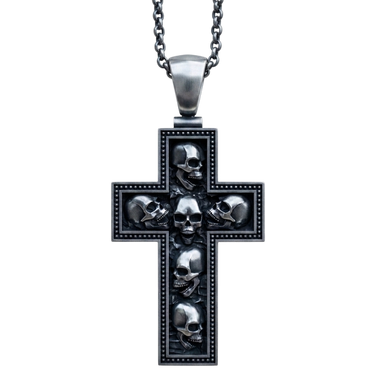


Men's beaded rosary pendants bring tactile texture and sacred geometry together through raised bead borders, granulation, and architectural framing. This collection features sterling silver pendants shaped as beaded Celtic crosses, skull-adorned Latin crosses, and eight-petal Gotland rosettes encircled by raised silver bosses. Every piece is cast in 925 sterling silver, finished in oxidized silver, polished silver, or warm gold vermeil.
Symbolism of Celtic crosses, skull emblems, and Gotland rosettes
A Celtic cross pairs flared arms with unbroken triquetra knotwork, representing eternal continuity and regional spiritual heritage. The beaded skull cross centers on six clustered skulls against a recessed backdrop, drawing upon traditional memento mori reflection on mortality. The Gotland rosette pendant draws from historic Scandinavian metalwork, where an eight-petal flower rests inside concentric bands of beaded silver bosses.
Selecting a beaded pendant for everyday wear
Choosing between these beaded silhouettes depends on the motifs and scale you favor. A Celtic beaded cross offers a balanced geometric profile suited for everyday heritage wear, while the skull cross creates a bolder, shadowed silhouette against dark fabrics. For those drawn to historical Northern European design, the Gotland rosette acts as a circular medallion with prominent raised granulation. These pendants pair naturally with understated finger bands such as Men's Band Rings, or complement heavier themes found in Men's Skull Rings and classic Men's Signet Rings.
Casting beaded textures in 925 sterling silver
Creating defined beadwork requires sharp metal definition during casting. Sarnion casts each pendant in 925 sterling silver to preserve the spacing between individual perimeter beads, sunken relief channels, and central emblems. Applying an oxidized silver finish darkens the recessed backgrounds behind the skulls and knotwork, allowing the polished high-relief beads and petal edges to catch light clearly. Vermeil and solid gold editions are also available upon request.
Occasions for gifting a beaded cross or medallion
Beaded silver crosses make meaningful gifts for rites of passage, milestones, or personal commemorations. The Celtic beaded pendant serves as a traditional gift for confirmations, birthdays, or celebrations of ancestral heritage. Historians and collectors of northern European art often appreciate the Gotland rosette medallion for its distinctive bossed geometry. The skull cross serves well for individuals who appreciate contemplative iconography and sharp textural detail.
